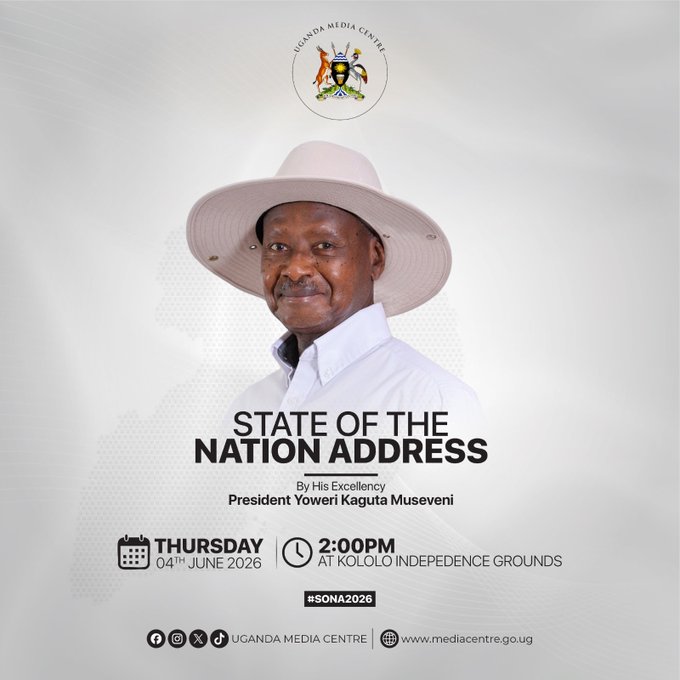
President Museveni has today delivered a pivotal State of the Nation Address at the Kololo Ceremonial Grounds, charting Uganda’s strategic path forward following his recent inauguration for another five-year term.
Addressing the newly inaugurated 12th Parliament, Museveni focused heavily on economic sovereignty, industrialization, and wealth creation.
The address comes on the heels of major legislative updates, including the newly enacted Protection of Sovereignty Bill, 2026, which Museveni emphasized would secure Uganda’s independent economic trajectory without alienating foreign investment.
The President stated that Uganda’s economy has established its foundation, calling on lawmakers to align the national budget with grassroots wealth creation initiatives.
He urged the new legislators to champion patriotism training to foster civic responsibility and safeguard the country’s socio-economic gains.
The President reiterated that the focus of his current term remains firmly rooted in the National Resistance Movement (NRM) 2026–2031 Manifesto, emphasizing commercial agriculture, manufacturing, and services.
Delivering a stern warning to public officials, Museveni warned “lazy and corrupt leaders” that his freshly appointed cabinet would prioritize strict accountability and rapid public service delivery.
He highlighted milestone developments, including the ongoing expansion of the regional Standard Gauge Railway, as crucial linchpins for boosting Uganda’s trade capacity within the East African Community (EAC).
In addition, President Yoweri Museveni has slammed what he described as a growing culture of dependence among leaders and public officials.
Museveni criticized Members of Parliament and government workers who demand allowances to carry out duties for which they are already paid.
Museveni said that he is angered by persistent demands for facilitation by some leaders, arguing that such attitudes undermine the country’s development efforts.
He said such attitudes hinder national development and stressed the need for self-reliance and service delivery.
The President’s remarks came as he showcased beneficiaries of initiatives such as the Parish Development Model (PDM), Emyooga, and the four-acre model, which he has consistently promoted as pathways to household income growth and socio-economic transformation.
He said that he used to ride a bicycle to serve his people, something he noted could be replicated by leaders.
Museveni contrasted the achievements of farmers and entrepreneurs who have embraced government programmes with leaders whom he accused of focusing on allowances rather than service delivery.
He maintained that Uganda’s transformation would depend on citizens embracing production and wealth creation rather than looking to the government for continuous support.
Museveni urged leaders at all levels to focus on helping wananchi understand and benefit from government programmes instead of prioritizing personal allowances and facilitation.
The President also reiterated his call for vigilance, hard work, and accountability, emphasizing that his campaign message should be understood as “Kisanja, No More Sleep” rather than the commonly quoted “Kisanja No Sleep.”
President Museveni used part of his address to clarify a slogan that has featured prominently in his political messaging noting that what he said was ‘Kisanja, No More Sleep,’ not ‘Kisanja No Sleep.'”
The President explained that the phrase was intended as a call for leaders and citizens to remain alert and focused on national development rather than becoming complacent.
He expanded the theme to include what he described as other priorities for the new term, declaring: “No more sleep, no more corruption, and no more politeness to leaders.”
Museveni argued that the country can only achieve faster transformation if public officials become more proactive in addressing challenges and if corruption is decisively tackled.
The President’s remarks appeared aimed at signaling a tougher stance on inefficiency and misconduct in public service as the government embarks on implementing its agenda for the new parliamentary term.