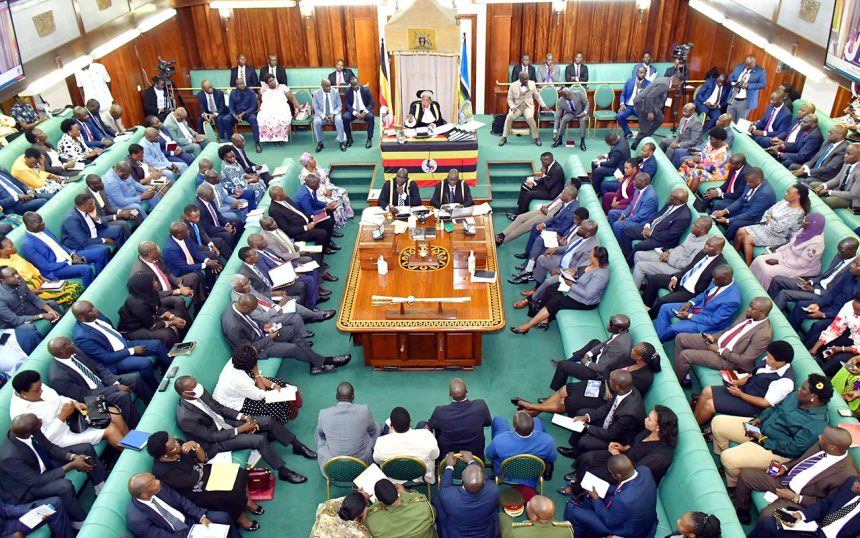
Parliament is today expected to debate and decide on the controversial Protection of Sovereignty Bill, 2026, amid growing criticism from opposition political parties and civil society organisations over clauses viewed as restrictive to political freedoms and foreign funding.
The proposed law seeks to regulate foreign influence in Uganda’s political, economic, and governance affairs. However, critics argue that several provisions could be used to limit the operations of opposition parties, civil society organisations, and individuals involved in political activism.
Last week, President Yoweri Museveni distanced himself from some sections of the original Bill, saying several restrictive clauses that sparked public concern were not part of the proposal he had presented to Cabinet.
According to Museveni, the initial objective of the Bill was to protect Uganda’s sovereign decision-making in areas such as legislation, socio-cultural values, economic policy, diplomacy, women’s affairs, and the military.
The President later directed the chairperson of the ruling National Resistance Movement caucus, Hamson Obua, together with relevant parliamentary committee leaders, to revise the Bill.
The earlier draft had proposed strict controls on foreign direct investment, remittances from Ugandans abroad, and external funding to religious organisations. However, the revised version now primarily targets individuals accused of engaging in activities deemed to undermine Uganda’s image, economy, or national interests in favour of foreign entities.
Some of the controversial amendments reportedly triggered heated disagreements and physical confrontations among Members of Parliament on the joint committees of Legal and Parliamentary Affairs and Defence and Internal Affairs during deliberations over the weekend.
Political leaders and civil society actors have continued to oppose the proposed legislation, calling for its complete withdrawal.
Mathias Mpuuga, president of the Democratic Front (DF), argued that the Bill lacks bipartisan support and is aimed at prolonging the NRM’s stay in power.
Meanwhile, Fred Ebil, secretary general of the Uganda Peoples Congress, said political parties depend on lawful foreign support to fund some of their activities and warned against restrictions that could cripple opposition operations.
Under the revised Bill, an “agent of a foreigner” is defined as any person who solicits, collects, or distributes money or other support intended to finance political activities in the interest of a foreign entity. Such individuals would be required to obtain licences from the Minister of Internal Affairs, subject to renewal every two years.
The president of the Forum for Democratic Change, Patrick Amuriat, warned that the law’s broad interpretation could be used to target opposition leaders and suppress dissent.
However, the revised proposal exempts Ugandans living abroad from being classified as foreigners and excludes several categories of funding from the law’s restrictions. These exemptions include regulated financial institutions, medical facilities, academic and research institutions, educational activities, commercial and family support, and faith-based organisations carrying out religious missions.
Government revised the Bill after strong opposition from stakeholders who appeared before Parliament’s joint committee, many of whom warned that the original proposal could negatively affect Uganda’s economy.
Among the strongest critics was Michael Atingi-Ego, Governor of the Bank of Uganda, who cautioned that restricting financial inflows could harm foreign direct investment, remittances, and Uganda’s economic growth ambitions.
The revised Bill now requires declaration of foreign funding exceeding Shs400 million instead of requiring prior ministerial approval, as proposed in the earlier draft.
Meanwhile, lawmakers on the joint parliamentary committees remain sharply divided over the legislation.
A group of 24 MPs signed a Majority Report supporting the revised Bill, while 11 legislators opposed to it prepared a Minority Report calling for its withdrawal.
Medard Lubega Ssegona, one of the legislators opposing the Bill, argued that existing laws already address the concerns the proposed legislation seeks to regulate.
Ssegona further accused the government of attempting to restrict political parties and well-wishers from mobilising foreign support for community services such as healthcare, education, and clean water projects that he said government has failed to adequately provide.